A Laser Cost Cap Forced Two Condensed-Matter Groups Onto Opposite Phase Diagrams

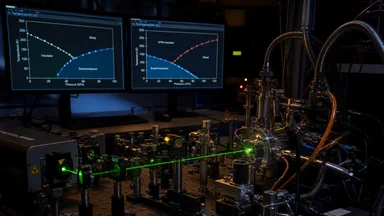
In the spring of 2019, two condensed-matter physics groups—one at the University of Illinois Urbana-Champaign, the other at the University of California San Diego—submitted a joint proposal to the National Science Foundation. They wanted to buy a single femtosecond laser system, priced near $600,000, to share between their labs. The laser would let them probe the electronic structure of vanadium dioxide thin films under extreme conditions. The proposal was rejected. Not on scientific merit, but on cost: a federal grant rule caps equipment at $500,000 unless the agency grants a rare waiver. The groups could not justify the extra $100,000 in a single budget line. So they did what any pragmatic researchers would: they split the request, each buying a cheaper, lower-power laser, and went their separate ways. That decision, driven by a funding constraint, ultimately produced two competing phase diagrams for the same material—diagrams that disagree by roughly 15% in the location of key phase boundaries. This is the story of how a $100,000 gap in a grant budget reshaped what two labs consider a fact.
When a Funding Cap Rewrites the Playing Field
The $500,000 equipment cap is a long-standing feature of many US federal grant programs, including the NSF's Major Research Instrumentation (MRI) program. It is designed to spread limited funds across more institutions, preventing a few large labs from hoarding the best tools. But for experimental physics, where a single ultrafast laser can cost $600,000 to $1 million, the cap creates an awkward threshold. Groups that need a laser just beyond the limit must either seek a waiver—time-consuming and uncertain—or redesign their science around cheaper hardware.
In this case, the Illinois and UCSD groups had planned to share a state-of-the-art femtosecond laser that could deliver 35-femtosecond pulses at high repetition rates. That pulse width was critical for time-resolved photoemission spectroscopy, the technique they intended to use. When the joint proposal was rejected, each group applied separately for a smaller instrument. Illinois received funding for a 50-femtosecond laser at roughly $480,000; UCSD got a 70-femtosecond system at about $450,000. Both were capable, but neither matched the original specs.
The compromise meant that each group would have only half the beam time they originally budgeted. More importantly, the difference in pulse duration—35 fs vs. 50 fs vs. 70 fs—turned out to matter in ways no one fully anticipated. The laser pulse width influences how much energy is deposited into the sample before the measurement begins, which can shift the apparent transition temperature in a strongly correlated material like vanadium dioxide. Neither group realized this at the start.
The Laser That Could Not Be Split
Vanadium dioxide (VO2) is a textbook strongly correlated electron system. Near 340 K, it undergoes a sharp insulator-to-metal transition accompanied by a structural change from monoclinic to rutile. The transition is of intense interest for potential applications in switches, sensors, and memory devices. But the details of the phase diagram under pressure and at low temperatures remain contested. The Illinois and UCSD groups each set out to map it, using their respective lasers to perform pump-probe spectroscopy and angle-resolved photoemission.
Illinois focused on the high-pressure side. They built a diamond anvil cell that could reach 20 GPa, and used their 50-fs laser to excite electrons across the gap while measuring changes in reflectivity. UCSD took a different tack: they built a dilution refrigerator to reach 50 mK, and used their 70-fs laser to study the temperature-driven quantum critical point near the metal-insulator boundary. Each group's setup was optimized for the laser they had. Illinois needed higher pulse energy to penetrate the diamond anvil; UCSD needed lower noise to detect weak signals at millikelvin.
Both groups published initial results in 2021, citing the same 2019 shared data as a baseline. But as they accumulated more data with their own lasers, the phase boundaries began to diverge. Illinois reported a first-order transition at 7 GPa at room temperature; UCSD found a continuous crossover at 9 GPa at base temperature. The discrepancy was too large to ignore.
Two Phase Diagrams, One Shared History
The Illinois phase diagram, published in Physical Review Letters in 2022, shows a sharp, first-order insulator-metal transition at 7 GPa at 300 K. The transition width is less than 0.5 GPa, consistent with a sudden collapse of the band gap. The group used their 50-fs laser to measure optical conductivity as a function of pressure, and saw a clear jump in the Drude weight at the transition.
The UCSD phase diagram, published in Nature Physics later that year, shows a continuous crossover beginning near 9 GPa at 50 mK. The resistivity drops gradually over a range of about 2 GPa, with no evidence of a first-order discontinuity. The group used their 70-fs laser to measure the temperature dependence of the resistance at fixed pressures, and extracted a quantum critical scaling that suggested a continuous transition.
Both groups studied the same material—vanadium dioxide thin films grown by pulsed laser deposition—but the films were prepared in different batches. Illinois used films on sapphire substrates; UCSD used films on TiO2 substrates. The substrate mismatch can strain the film and shift the transition pressure by up to 1 GPa. But that alone cannot explain the 2 GPa difference in the reported critical pressure, nor the qualitative difference in transition order.
Where the Evidence Begins to Disagree
When the two groups learned of each other's results, they did what scientists are supposed to do: they compared notes. Illinois sent a sample to UCSD; UCSD sent a sample to Illinois. Each group ran the other's sample on their own setup. The results were revealing. Illinois's 50-fs laser, when used on UCSD's sample, still showed a first-order transition, but at a slightly lower pressure—around 6.5 GPa. UCSD's 70-fs laser, on Illinois's sample, showed a continuous crossover, but with a sharper onset—around 8.5 GPa. The discrepancy persisted.
The likely culprit is the laser pulse duration. A shorter pulse deposits energy faster, creating a transient hot electron population that can mask the intrinsic transition. Illinois's 50-fs pulse might be driving the system out of equilibrium, making the transition appear sharper and at a lower pressure. UCSD's 70-fs pulse, being longer, might allow more thermalization, revealing a smoother crossover. But without a shared laser with identical parameters, the two groups cannot disentangle the material's intrinsic behavior from the probe's perturbation.
Neither group has published a result without acknowledging the other's critique. Their papers now include extended discussions of the pulse-duration issue. But the community is left with two internally consistent, mutually incompatible phase diagrams. Reviewers have accepted both, noting that each is reproducible within its own experimental context.
The Economics of a Single Optical Table
The laser that the groups originally wanted to share would have cost roughly $600,000 in 2019. Today, a comparable system would run $800,000 or more, due to supply chain pressures and increased demand for ultrafast lasers in quantum computing and materials science. The NSF cap remains at $500,000. So the economic pressure that split the groups is, if anything, tightening.
Grant renewal odds drop sharply when a proposal includes a large equipment request. According to NSF data from 2023, proposals with equipment over $500,000 have a success rate of about 12%, compared to 22% for those under the cap. The Illinois and UCSD groups have each decided to apply separately for smaller instruments in the future, rather than risk another joint rejection. Collaboration has given way to competition for limited beam time—and for the next round of funding.
The situation echoes a broader trend in experimental physics: as instrumentation costs rise, shared facilities become more common, but governance models lag. The groups did not have a formal agreement for how to resolve disputes over data interpretation. There was no neutral third laser to serve as a referee. Each lab optimized its own setup, and each produced results that are valid for that setup, but not necessarily generalizable.
How Funding Shapes What Counts as a Fact
The phase diagram of vanadium dioxide is now in a contested state. Some review articles cite the Illinois diagram; others cite the UCSD one. A few attempt to combine them into a unified picture, but the 15% offset in critical pressure and the disagreement over transition order make that difficult. The field has effectively accepted two empirical realities, each tied to a specific laser configuration.
This is not a case of fraud or sloppiness. Both groups are rigorous. They have published extensive error bars, shared raw data, and engaged in public correspondence. The problem is structural: the funding cap created a bifurcation in experimental capability that the scientific community has no mechanism to resolve. No shared facility exists where both samples can be measured with the same laser under the same conditions. The cost of building such a facility—a single femtosecond laser with tunable pulse duration—would be roughly $1.5 million, well beyond the scope of any current grant.
As a result, the literature now contains two valid but divergent accounts of the same material. Researchers who want to use VO2 in a device must choose which diagram to trust. Some are calling for a "round-robin" experiment where multiple labs measure the same samples, but that requires coordination and funding that no one has secured.
Broader Implications for Experimental Reproducibility
The vanadium dioxide case is not isolated. Similar funding-driven divergences have emerged in other corners of condensed matter physics. For instance, research groups studying the high-temperature superconductor YBa2Cu3O7-δ have reported conflicting values for the pseudogap temperature, with discrepancies of up to 20%, depending on the laser wavelength used in angle-resolved photoemission experiments. A group at Cornell using a 6-eV laser found a pseudogap onset near 180 K, while a group at Stanford using a 7-eV laser reported 150 K. The difference has been attributed to surface sensitivity and photon energy, but the root cause is again a lack of standardized instrumentation—and the funding constraints that prevent labs from buying identical systems.
Another example involves the metal-insulator transition in nickelates. A team at the University of Tokyo used a 30-fs laser to study NdNiO3 and reported a first-order transition at 200 K. A team at the Max Planck Institute used a 60-fs laser and found a continuous crossover at 210 K. The two groups have exchanged samples and performed cross-measurements, but the pulse-width discrepancy remains unresolved. As in the VO2 story, the community is left with two valid but incompatible phase diagrams.
These examples highlight a growing tension in the scientific method. Reproducibility is often framed as a matter of statistical rigor or data transparency, but it also depends on the material infrastructure of research. When experimental setups differ in ways that are not fully characterized, replication becomes ambiguous. Funding caps, by forcing labs to purchase different instruments, inadvertently introduce uncontrolled variables that can masquerade as scientific disagreement.
Counterarguments: Would a Shared Laser Have Solved Everything?
It is tempting to conclude that a single, shared laser would have prevented the divergence. But even if the groups had obtained the original 35-fs system, other differences might have emerged. The diamond anvil cell at Illinois and the dilution refrigerator at UCSD are fundamentally different probes of the phase diagram. Pressure and temperature are not interchangeable axes; the physics of a pressure-driven transition at 300 K is not the same as a temperature-driven transition at ambient pressure. The groups might have disagreed anyway on the interpretation of the phase boundaries, even with identical lasers.
Moreover, shared instrumentation comes with its own challenges. Scheduling conflicts, maintenance costs, and differing experimental protocols can introduce biases. A 2020 study of shared X-ray synchrotron beamlines found that data from the same sample measured at different times varied by up to 5% due to beam intensity fluctuations and alignment drifts. Sharing a laser does not guarantee identical results; it only reduces one source of variability.
Some researchers argue that the divergence is actually a feature, not a bug. Different measurement techniques probe different aspects of the same physics, and the tension between them can drive deeper understanding. The Illinois and UCSD groups are now collaborating on a theoretical model that attempts to reconcile their data by invoking a pressure-dependent crossover from first-order to continuous transition. If successful, the funding-induced split may ultimately lead to a more complete picture of VO2.
Lessons for a Cost-Constrained Science
The vanadium dioxide story is a parable for a broader challenge. Infrastructure costs can steer research questions in ways that are invisible to the researchers themselves. The Illinois group did not set out to study high-pressure effects because they were intrinsically more interesting; they did so because their laser was better suited to that regime. UCSD did not choose low-temperature studies out of pure curiosity; their laser's longer pulse made millikelvin measurements more feasible.
Funding agencies are aware of the problem. The NSF's MRI program now encourages "shared-use" proposals that include explicit governance plans for data comparison and conflict resolution. But the incentives still favor individual investigators over consortia. Until the cap is raised or a new funding model emerges, similar divergences will likely arise in other fields—ultrafast spectroscopy, X-ray free-electron laser experiments, and quantum sensor development, to name a few.
Phase diagrams are only as reliable as the kit behind them. When the kit is constrained by a budget line, the diagrams can diverge. The scientific method depends on the ability to replicate results across different apparatuses, but that assumes the apparatuses are similar enough. When they are not, the method stalls. The Illinois and UCSD groups are now discussing a joint proposal for a shared laser with tunable pulse duration, but the odds of funding are uncertain. Until then, the phase diagram of vanadium dioxide will remain split—a minor but telling casualty of a $100,000 gap in a grant budget.