Train Timing Shifts Sunday at Konya Whirling Dervish Festival When Extra Cars Overfill

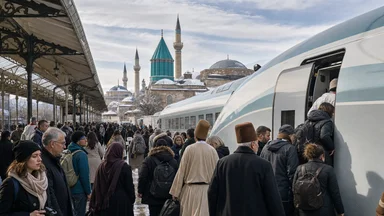
Every December, the central Turkish city of Konya swells with pilgrims and tourists attending the Şeb-i Arus festival, a week-long commemoration of the poet Rumi's death. The event is beautiful, moving, and — for anyone trying to move around the city — a logistical puzzle. Train schedules shift, hotels triple their rates, and the crowds at the Mevlana Museum can feel like a human tide. This is a plain-English guide to what actually happens, grounded in what locals do rather than influencer advice.
Why the Konya Festival Trains Run Late on Sundays
Turkish State Railways, known as TCDD, adds extra cars to its high-speed YHT trains between Ankara and Konya during the festival. That sounds helpful, but it creates a knock-on effect. With more passengers boarding at each stop, platform dwell time extends by roughly five to ten minutes. On Sundays — when domestic visitors and day-trippers peak — the delays compound. A train that normally arrives in Konya at 10:30 AM might pull in closer to 10:45 AM.
The schedule shift is most noticeable on morning departures. The 8:00 AM YHT from Ankara often leaves on time but arrives late because of the extra boarding time at intermediate stations like Polatlı. Regular riders know this and adjust their plans. Some take the 6:30 AM train instead. Others book seats on the overnight İstanbul–Konya train, which departs roughly 30 minutes earlier than usual during festival week to balance the network.
TCDD posts updated timetables on its website and mobile app, but the announcements at Konya station are in Turkish only. If you do not speak the language, check the app before heading out. The station staff are helpful but overwhelmed during peak hours. A printed copy of your ticket helps, as phone signals can be patchy inside the station when thousands of people are trying to load the same page.
For those coming from İstanbul, the overnight train is a popular choice. It leaves around 9:00 PM and arrives in Konya the next morning. During the festival, the return trains from Konya depart after 10 PM to accommodate evening ceremonies. If you are planning a day trip, be prepared for a late return. The last YHT back to Ankara often leaves around 11 PM, but it can sell out days in advance.
The delay pattern is not unique to Konya. During major events worldwide, railways often add capacity but struggle with dwell time. For a parallel example, see our article on three railway days in Portugal split by a bus. The principle is similar: added capacity often means added delays.
Whirling Dervishes Draw 2.5 Million Visitors Each December
The Şeb-i Arus festival, meaning "night of union," commemorates the death of the Sufi poet Jalal ad-Din Muhammad Rumi on December 17, 1273. For Rumi's followers, this was not a loss but a reunion with the divine. The festival runs from December 7 to 17, with the main ceremonies held at the Mevlana Cultural Center. Attendance has grown steadily; some estimates put the total number of visitors near 2.5 million over the ten-day period.
The peak days are December 16 and 17, when the most famous sema (whirling) ceremonies take place. Hotels in Konya book out weeks ahead. A dorm bed in a hostel that normally costs TRY 500 can jump to TRY 1,500. Mid-range hotels near the Mevlana Museum often charge TRY 2,500 to TRY 4,000 per night during the festival, compared to TRY 800 in low season.
Local buses and trams see triple their usual ridership. The tram line from the train station to the Mevlana Museum is packed from early morning until late evening. Many visitors find it faster to walk the roughly 2 kilometers if they are able. Taxis are available but surge pricing is common; a short ride that normally costs TRY 50 might run TRY 150.
Train capacity is doubled during the festival week. TCDD adds extra cars to high-speed services and runs additional regional trains from nearby cities like Karaman and Aksaray. Even so, seats sell out quickly. If you are booking last-minute, consider a bus instead. The Konya otogar (bus station) is well-connected, and companies like Kamil Koç and Metro run frequent services from major cities. Buses are less prone to the dwell-time delays that affect trains, though they can get stuck in traffic near the Mevlana Museum.
One trade-off to consider: buses from Ankara take roughly 3 hours versus 90 minutes by train, but they drop you closer to the city center. If your lodging is near the otogar, a bus might save you a tram ride. For travelers from İstanbul, the bus journey is about 8 hours overnight, similar to the train but with more flexible departure times. Many locals prefer the bus for last-minute trips precisely because it is less likely to sell out completely.
What Locals Do That Tourists Miss
Longtime Konya residents have developed strategies to avoid the worst of the crowds. One common tactic is taking early morning trains before the rush. The 6:30 AM YHT from Ankara arrives in Konya around 8:00 AM, well before the first ceremony. These trains are less crowded, and you can walk to the Mevlana Museum before the queues form.
Locals also buy round-trip tickets days in advance. They know that same-day purchases often mean standing or no seat at all. Many have family or friends outside the city center and stay with them, avoiding the hotel price surge. They take the tram or a dolmuş (shared minibus) from the outskirts into the center each morning. A dolmuş ride from a neighborhood like Meram costs around TRY 10 and takes 20 minutes, compared to a taxi that might cost TRY 50 in normal traffic.
Another local habit is avoiding the main ceremony hall on the final night. The December 17 sema is the most famous, but it is also the most crowded. Tickets are nearly impossible to get without booking months ahead. Instead, locals attend smaller ceremonies at other venues, such as the Şerafettin Mosque or the Aziziye Mosque, where the atmosphere is more intimate and the crowds thinner. These events are free and open to all, though they start earlier, around 6 PM, to avoid conflicting with the main ceremony.
Street food vendors near the Mevlana Museum are a favorite among residents. They sell traditional Konya dishes like etli ekmek (a flatbread with minced meat) and bamya çorbası (okra soup). These are cheaper and more authentic than the restaurant options along the main square. A plate of etli ekmek costs around TRY 60, while a sit-down meal in a tourist-oriented restaurant can run TRY 150 or more. The vendors also serve ayran (a salty yogurt drink) for about TRY 15, which locals swear by for digestion after a heavy meal.
Residents also know which tram stops to avoid. The stop at the Mevlana Museum is the busiest, but getting off one stop earlier at Alaaddin Hill and walking the remaining 1 kilometer can save you 15 minutes of queueing to board. Similarly, on the return, walking to the next stop reduces wait time. This kind of micro-navigation is second nature to locals but rarely appears in guidebooks.
Booking a Bed: Ground-Truth Lodging Costs
Hostel dorm beds in Konya during the festival typically range from TRY 500 to TRY 800 per night. That is roughly double the off-season rate. Mid-range hotels, such as the Rumi Hotel or the Hich Hotel, charge between TRY 1,500 and TRY 2,500 per night for a double room. The higher-end Dedeman Konya or Hilton Garden Inn can exceed TRY 4,000.
Prices triple during the festival week compared to early December. If you book three months ahead, you can often secure a room at the lower end of these ranges. Last-minute bookings, especially after December 10, are slim pickings. Many hotels require full prepayment for festival dates and have strict cancellation policies. Some hotels offer a discount for booking the entire week, but you pay upfront and lose everything if you cancel.
Airbnb listings surge during the festival, but they are not always reliable. Some hosts cancel at the last minute to re-list at higher prices. If you use Airbnb, look for listings with multiple positive reviews and a "superhost" badge. A private room in a local's apartment can be a good deal, often around TRY 800 to TRY 1,200 per night. However, be aware that many apartments lack central heating; Konya in December is cold, with temperatures dropping to around 0°C at night. Check that the listing mentions heating or a space heater.
For budget travelers, consider staying in a neighboring city like Karaman, Aksaray, or even Ankara. The YHT from Ankara takes about 90 minutes, and hotels there are far cheaper. A dorm bed in Ankara costs roughly TRY 200 to TRY 300 per night. You lose time commuting, but you gain flexibility and avoid the Konya price spike. The trade-off is that you miss the early morning atmosphere and may arrive after queues have formed. If you choose this option, book the earliest train to maximize your day.
Another option is to stay in a hostel outside the city center, such as in the Meram district. Hostels there charge around TRY 400 per night during the festival, roughly half the center's rate. The tram ride to the museum takes 20 minutes, and you are close to the Meram vineyards, a pleasant area for an evening walk. The catch is that these hostels are less likely to have English-speaking staff, so a translation app is useful.
Train Timing Shift: What the Schedule Shows
The Ankara–Konya YHT adds roughly 10 to 15 minutes to its journey time on Sundays during the festival. Normally a 90-minute trip, it stretches closer to 105 minutes. The İstanbul–Konya overnight train departs 30 minutes earlier than its usual 9:30 PM schedule, leaving at 9:00 PM. This shift is designed to allow the train to arrive in Konya before the morning ceremonies start.
Return trains from Konya to Ankara depart after 10 PM on festival days. The last departure is often around 11:00 PM, but it can sell out by midday. If you are attending an evening sema, book your return ticket as soon as you arrive in Konya. The station ticket office has long queues, but the online system works well if your phone has signal. One counterintuitive tip: book a slightly earlier return than you think you need. The ceremonies sometimes run long, but if you finish early, you can exchange your ticket at the station for a later train if seats are available.
Station announcements are made in Turkish only. Key phrases to listen for: "Ankara YHT" (the high-speed train to Ankara), "İstanbul Mavi Tren" (the overnight train to İstanbul), and "peron" (platform). The digital boards show departure times in 24-hour format. If you are unsure, ask a uniformed station attendant. They are used to foreign visitors and will point you to the right platform. However, during peak hours, attendants may be rushed. A polite "Afedersiniz" (excuse me) helps.
TCDD's website and mobile app provide live updates, but they can be slow during peak hours. A printed ticket or a screenshot of your e-ticket is essential, as phone networks sometimes fail in the crowded station. The app also shows which trains have extra cars added — look for the "ilave vagon" notation. These trains are less likely to be overfilled. If you see "ilave vagon" on your train, it is a good sign that the railway is anticipating demand.
One nuance: the schedule shift is not uniform across all trains. Some conductors try to make up time by reducing dwell at less busy stations, so the actual delay varies. If punctuality is critical, avoid the 8:00 AM and 5:00 PM trains, which are the most crowded. The 10:00 AM and 2:00 PM services tend to run closer to schedule.
Three Items That Save Your Trip
First, a printed train ticket. Phone signals in Konya station during the festival are unreliable. Hundreds of people trying to load the same app at once can bring the network to a crawl. A paper ticket or a screenshot on your phone ensures you can board without hassle. Second, earplugs. The sema ceremonies are loud — the ney flute and chanting can reach uncomfortable volumes. Earplugs let you focus on the spiritual experience without pain.
Third, cash in small denominations. Taxis and street food vendors often do not accept cards. ATMs near the Mevlana Museum run out of cash by midday. Bring enough Turkish lira for the day, ideally in 10, 20, and 50 lira notes. A reusable water bottle is also useful; there are drinking fountains in the Mevlana Museum courtyard. And comfortable shoes are a must — the streets around the museum are cobblestone, and you will walk several kilometers.
If you are staying in a guesthouse, check whether it provides reliable WiFi. Many budget places struggle with the surge in users. For a cautionary tale, see our piece on Dorset guesthouse WiFi drops at 9pm. The same dynamic applies in Konya: a hostel lounge with a strong connection can be a lifesaver.
Finally, consider buying a local SIM card. Turkish providers like Turkcell and Vodafone offer tourist SIMs with data packages. They are cheap and give you a reliable connection when public WiFi fails. You can buy them at the airport or at shops in the city center. A 10 GB package costs around TRY 150 and lasts 30 days. This is especially useful for navigation and checking train times on the go.
When to Go If You Want Fewer Crowds
The obvious answer is early December, before the festival starts. December 1 to 6 sees normal crowds and lower prices. The Mevlana Museum is open and mostly empty. You can still see the whirling dervish performances at the cultural center on weekends, but without the festival surge. Another good window is the week after December 17, when most visitors have left.
Weekday visits are far less crowded than weekends. The Tuesday and Wednesday ceremonies are smaller and more intimate. Morning sessions starting at 10 AM are less packed than evening ones. If you can attend a sema at 10 AM rather than 8 PM, you will have more space and a better view. The downside is that morning light is harsh for photography, but the atmosphere is calmer.
Avoid the final two days, December 16 and 17, if you dislike crowds. Those days account for more than half of the total festival attendance. The atmosphere is electric, but the logistics are a nightmare. If you do go, arrive at the Mevlana Cultural Center at least two hours early to get a seat. Bring a book or download podcasts, as you will wait in line. The center opens doors 90 minutes before the ceremony, but the queue forms much earlier.
For a completely different experience, consider visiting Konya in April or May. The weather is mild, the tulips are blooming, and there is no festival surge. Hotels are cheap, trains run on time, and you can explore the city's Seljuk architecture without jostling through crowds. The Mevlana Museum is still worth a visit, and you will have the place nearly to yourself. April also sees the International Konya Mystic Music Festival, a smaller event that draws fewer visitors but offers similar spiritual music.
If you are planning a trip around a specific event, be prepared for schedule changes. For another example of how festivals affect transport, see our guide to Phong Nha dry season morning gate opens at 6am. The lesson is universal: plan ahead, expect delays, and book early.
Counterarguments: When the Festival Is Worth the Hassle
Despite all the warnings, many travelers find the Şeb-i Arus festival profoundly moving. The synchronized whirling of dozens of dervishes, the live ney music, and the collective silence during prayer create an atmosphere unmatched at other times of year. If you are a devoted Rumi follower or a photographer seeking dramatic images, the crowds are a price worth paying.
Some argue that the festival's popularity has improved infrastructure. TCDD now runs more trains than a decade ago, and the Mevlana Cultural Center has expanded seating. The city has also added more trams to the line serving the museum. These improvements mean that despite the surge, the experience is more manageable than it was in the 2010s. For example, in 2015, the tram line was a single track with 10-minute headways; now it is double-track with 4-minute headways during peak times.
Another counterpoint: the festival brings a celebratory mood that is absent in low season. Street performers, special exhibitions at the museum, and extended hours at historical sites add value. The Mevlana Museum stays open until 9 PM during the festival, compared to 5 PM normally. This allows you to visit after the crowds thin in the evening.
Ultimately, the decision depends on your tolerance for crowds and your budget. If you can afford the higher prices and plan meticulously, the festival is a once-in-a-lifetime experience. If not, Konya is equally rewarding in quieter months.