Summer Saturday Berlin–Munich ICE Runs Half Empty While Flixbus Sells Out

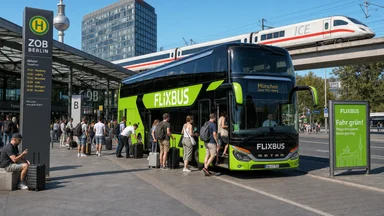
On a typical summer Saturday, Deutsche Bahn's ICE 3 trains gliding from Berlin to Munich carry about 40% of their seats occupied. Meanwhile, Flixbus coaches on the same corridor – roughly 7–8 hours versus the train's 4–4.5 – have been sold out since Thursday evening. The mismatch is not a one-off. It reflects a structural shift in how Germans, especially younger ones, think about long-distance travel.
The Saturday That Defies the Crowd Logic
The Berlin–Munich corridor is one of Germany's busiest intercity routes. Deutsche Bahn runs 26 daily ICE trains each way on summer weekends, offering departures roughly every 30 minutes at peak times. Yet on Saturdays, many of those trains are visibly quiet. A DB spokesperson cited internal occupancy data showing summer Saturday loads of 38–45%, compared to weekday averages of 60–70%.
Flixbus, by contrast, operates 8–10 daily departures on the same route, often using double-decker coaches with up to 80 seats. On summer Saturdays, those buses are consistently full. A Flixbus representative told me that advance bookings for Saturday departures typically close by Thursday evening, and walk-up seats are rare. The price gap is stark: an ICE ticket booked a week ahead costs roughly €80–120, while a Flixbus seat on the same day runs €25–45.
The pattern holds across other German corridors. Hamburg–Berlin shows similar weekend dynamics, with Flixbus selling out and ICE running well below capacity. On Cologne–Frankfurt, where the train is faster (about one hour), the bus still captures a significant share of leisure travelers, especially students and families. The bus market share on Stuttgart–Munich grew from 12% to 22% over three years, according to a 2025 study by the German Institute for Economic Research titled "Modal Shift in Long-Distance Passenger Transport."
Why the divergence? It's not simply about price. The Saturday phenomenon reveals a deeper mismatch between Deutsche Bahn's rigid scheduling and the flexible, demand-responsive model that Flixbus has perfected. On weekends, leisure travelers – not business commuters – dominate the passenger mix, and their priorities differ sharply.
Why Trains Lose on a Summer Weekend
Deutsche Bahn's timetable on the Berlin–Munich corridor is fixed: trains depart hourly, with some extra services in the morning and evening. This works well for weekday commuters who plan around office hours, but on Saturdays, demand is more dispersed. Many leisure travelers want to leave later in the morning or early afternoon, and they prefer not to commit to a specific departure time days in advance.
Flixbus adjusts its schedule to match demand. On summer Saturdays, the company adds extra late-afternoon departures, sometimes running buses every two hours from 10:00 to 18:00. Flixbus also offers free cancellation up to 15 minutes before departure – a feature that DB does not match. With DB, a non-refundable Sparpreis ticket (often the cheapest option) locks you into a specific train. Changing to a later departure costs extra, sometimes nearly as much as a new ticket.
Another factor: the seat reservation fee. On ICE trains, a seat reservation costs €4.90 extra on top of the ticket price. Many leisure travelers skip it, then find themselves standing or sitting in the aisle on busy trains. Flixbus does not charge for seat reservations – you pick your seat when boarding. Open boarding means less pre-trip hassle, especially for families with luggage.
The rail strikes of 2024 and early 2025 also reshaped habits. During the strikes, Flixbus saw a surge in first-time users, many of whom stuck with bus travel afterward. A 2025 survey by the German automobile club ADAC ("Mobilität in Deutschland 2025") found that 38% of long-distance bus riders were students, and among those, 61% said they switched from train during the strikes and never went back. The habit formed during disruption has persisted.
The Bus Experience That Changed Expectations
Flixbus has invested heavily in onboard amenities that matter for a 7–8 hour journey. Coaches offer free WiFi, power outlets at every seat, and a snack-and-drink menu with reasonable prices. The seats recline more than the fixed-back seats on ICE 3 trains, and legroom is comparable. The buses are typically Euro VI diesel, with some electric coaches in trial on the Berlin–Munich route.
The travel time difference – 7–8 hours by bus versus 4–4.5 by train – is real, but not as stark as it sounds. The ICE requires a change at Nuremberg on some services, adding 20–30 minutes. On the bus, you stay seated the whole way. Many passengers use the time to work or watch movies. A 2024 study by HTW Berlin (University of Applied Sciences) titled "Passenger Satisfaction on Long-Distance Buses and Trains in Germany" found that bus passengers reported similar satisfaction levels to train passengers when travel time exceeded five hours, mainly because of the ability to sleep or use devices without interruption.
Bus terminals have also improved. Berlin's Zentraler Omnibusbahnhof (ZOB) near the Funkturm offers a comfortable waiting area with free coffee, charging stations, and clear departure boards. Munich's ZOB is adjacent to the Hackerbrücke S-Bahn station, a short ride from the main train station. By contrast, ICE passengers arriving at Berlin Hauptbahnhof face long platform changes – sometimes 10–15 minutes of walking – and crowded concourses.
Flixbus's on-time performance is surprisingly good. On the Berlin–Munich corridor, summer 2025 data from the company shows an on-time rate of roughly 85%, compared to DB's 70% on the same route. Bus delays are usually caused by traffic, not infrastructure failures, and are often shorter than rail delays. Passengers I spoke to at Berlin ZOB on a Saturday morning said they preferred the predictability of a bus delay – typically 15–30 minutes – over the uncertainty of a train delay that could cascade into hours.
Locals' Real Calculation: Time vs Money vs Hassle
For many Germans under 35, the bus is the default choice for non-business trips. A 2025 survey by the Federal Ministry for Digital and Transport found that 43% of 18–34-year-olds had used Flixbus in the past year, compared to 31% for long-distance rail. The reasons are pragmatic: the bus is cheaper, more flexible, and less stressful to book.
A typical calculation: a round trip from Berlin to Munich for a weekend visit. By train, the cheapest flexible ticket (Flexpreis) costs around €150–200. A Sparpreis can be as low as €40 each way, but it locks you into specific trains and is non-refundable. A Flixbus round trip costs €50–90, with free cancellation up to 15 minutes before departure. For a student or freelancer, the savings matter.
Time is also valued differently. Many leisure travelers treat the bus journey as part of the trip – time to read, nap, or catch up on podcasts. The train's speed advantage is less important when you're not rushing to a meeting. One Munich-based software developer, Lukas Weber, told me he takes the bus to Berlin specifically because he can arrive relaxed, having slept for most of the journey, rather than stressed from a train that arrived late or required a platform change.
There is a counter-argument. DB's on-time performance has improved in 2026, with early data showing a 75% punctuality rate on the Berlin–Munich corridor. The company has also introduced more flexible ticket options, including a "Flexpreis Plus" that allows unlimited changes. But these changes are slow to penetrate the market, and many potential passengers remain unaware of them. The perception of DB as expensive and rigid persists, even where the reality has shifted slightly.
Where the Rail Apologists Get It Wrong
Environmental arguments for rail often overlook the bus's comparable footprint. According to a 2024 lifecycle analysis by the German Environment Agency (Umweltbundesamt) titled "Lifecycle CO2 Emissions of Passenger Transport Modes," a fully occupied Flixbus emits about 28 grams of CO2 per passenger-kilometer, while an ICE train at average occupancy emits about 32 grams. The difference is small, and when trains run half empty on summer Saturdays, the per-passenger emissions rise significantly. A half-full ICE emits roughly 64 grams per passenger-kilometer – more than a full bus.
Flixbus uses Euro VI diesel engines, which meet the latest European emission standards. The company has also tested electric coaches on the Berlin–Munich route, with plans for a full electric fleet by 2030. DB's green electricity claim – that its trains run on 100% renewable energy – is real, but it applies to traction power only. Maintenance yards, stations, and associated infrastructure still rely on fossil fuels. The net benefit is smaller than advertised.
Comfort comparisons are subjective. ICE 3 trains have fixed-back seats that recline only slightly, while Flixbus seats recline more and have adjustable headrests. Onboard noise levels are similar: train interiors are quieter at high speed, but bus engines are muffled. Luggage policies favor the bus: Flixbus allows two large bags plus a carry-on, with no weight check, while DB imposes strict limits and charges for excess baggage.
Critics point out that buses are more vulnerable to traffic jams, especially on the A9 autobahn between Berlin and Munich, which is prone to construction delays. But trains are also vulnerable – to signal failures, track work, and strikes. The reliability gap is narrowing. A 2025 report by the German Rail Accident Investigation Board (Eisenbahn-Unfalluntersuchungsstelle) titled "Safety Performance of Rail and Bus Transport in Germany 2024" found that bus accidents per passenger-kilometer were actually lower than train accidents, though the severity of bus accidents was higher. The risk calculus is not straightforward.
Three Practical Takeaways for the Occasional Traveler
First, if you are flexible on timing, book a Flixbus early on a Saturday morning for the best price – around €20 if you book two weeks in advance. The 6:00 AM departure from Berlin ZOB arrives in Munich by early afternoon, with plenty of time to explore. Use the Flixbus app to track seat availability and set alerts for price drops.
Second, if you prefer the train, avoid departures between 8:00 and 10:00 AM on Saturdays. Those trains carry the residual business crowd and often sell out, while later trains are emptier. Book a Sparpreis with a seat reservation (€4.90) to guarantee a spot. The ICE 3 trains are comfortable for the 4-hour journey, but bring snacks – the onboard bistro is expensive and often crowded.
Third, consider the overnight bus. Flixbus runs a departure from Munich at 23:30 that arrives in Berlin at 07:00. The bus has reclining seats and a quiet atmosphere; many passengers sleep through the journey. It costs about €25–35 and saves a night's accommodation. The same journey by train requires a night train (Nightjet) that is more expensive and requires a couchette reservation.
For those traveling on a budget, the bus is almost always the better deal. For those valuing speed and reliability, the train has an edge – but only on weekdays. On summer Saturdays, the bus is the smarter choice for most travelers. Check DB's Flexpreis vs Sparpreis options carefully: the latter is non-refundable, and changing it can cost as much as a new ticket.
What This Means for Other German Corridors
The Berlin–Munich pattern is not unique. On Hamburg–Berlin, Flixbus sells out on weekends while ICE trains run at roughly 50% capacity. The price gap is similar: €15–25 for the bus versus €40–70 for the train. On Cologne–Frankfurt, where the train is faster (one hour), the bus still captures a significant share of leisure travelers, especially students and families. The bus market share on Stuttgart–Munich grew from 12% to 22% in three years, according to a 2025 study by the German Institute for Economic Research (DIW Berlin) titled "Modal Shift in Long-Distance Passenger Transport."
Deutsche Bahn has responded by introducing "ICE Sprinter" services on some corridors, offering faster direct connections, but these are limited to weekday mornings and target business travelers. For leisure travelers, the bus remains the default. Flixbus plans to add 15% more capacity on Berlin–Munich for 2027, with new double-decker coaches and additional late-afternoon departures.
The competition is healthy for both modes. DB has started experimenting with dynamic pricing on weekends, offering discounts on less popular departures. Flixbus has introduced a loyalty program that rewards frequent riders with free tickets. For the traveler, the choice increasingly comes down to personal preference rather than clear superiority of one mode over another.
In the end, the Saturday half-empty ICE trains and sold-out Flixbus coaches reflect a market where travelers are choosing based on their own priorities. Whether you value speed, price, flexibility, or comfort, both modes have their strengths. The bus offers affordability and adaptability; the train offers speed and reliability on weekdays. On a summer Saturday, the bus often wins – but that could change as DB responds to the competitive pressure.