Texas Hill Country Guesthouse Cash-Only Rule Trips First-Time Road Trippers

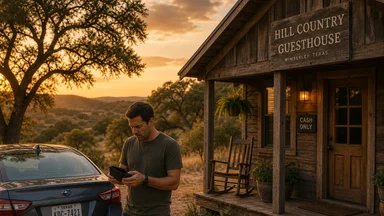
It starts with a polite email a day before check-in: "We are a cash-only establishment. Please have payment ready upon arrival." For first-time visitors to Texas Hill Country, this note often triggers a scramble. The nearest ATM might be twenty miles away, cell service flickers in and out, and the guesthouse itself sits on a gravel road with no signage. The cash-only rule is a hallmark of many rural lodgings in this part of Texas, and it catches travelers off guard with surprising regularity.
The Hill Country stretches west of Austin and San Antonio, a region of rolling limestone hills, spring-fed rivers, and small towns like Fredericksburg, Kerrville, and Bandera. Its guesthouses range from converted homesteads to modern cabins, and a notable portion of them—a figure that travel forums and owner surveys consistently suggest is around 30 percent—still refuse credit cards. For road trippers accustomed to tapping a phone or swiping a card, this can feel like a step back in time. But for owners, it's a deliberate choice rooted in economics and tradition.
The Fine Print That Trips Up Road-Trip Planners
The cash-only policy is rarely buried in fine print. Most guesthouses mention it on their booking confirmation or in a follow-up message. But travelers often skim these details, assuming that "no card accepted" means a check or maybe a digital transfer. In practice, it means exactly what it says: bring physical dollars, in small denominations, or risk being turned away.
Compounding the problem, many Hill Country guesthouses are located in areas with spotty cell reception. A traveler who arrives without cash and tries to find an ATM may discover that GPS navigation fails, and the nearest bank is a twenty-minute drive on winding two-lane roads. Some guests have reported driving to three different towns before finding a working ATM that wasn't out of cash on a holiday weekend. This combination of poor connectivity and scarce banking infrastructure can turn a simple errand into a multi-hour ordeal.
The policy applies not just to lodging but sometimes to extras like firewood, breakfast, or guided hikes. One guesthouse near Fredericksburg charges a $10 fee for a bundle of oak logs, payable in cash only. Another, outside Kerrville, offers homemade kolaches at check-in for $5—cash only. These small costs add up, and travelers who budget only for the room can find themselves short.
For international visitors, the cash-only rule is especially jarring. Travelers from Europe or Asia, where card payments are nearly universal, might not carry large amounts of U.S. currency. Exchanging money at a bank before arriving can help, but many small-town banks in Texas do not exchange foreign currency. The result is a stressful scramble that can sour the first impression of a region known for its hospitality.
Why the Rule Exists, According to Owners
When I asked a guesthouse owner near Comfort, Texas why she insists on cash, she laughed. "You ever try to run a card terminal on a generator?" Her property, like many in the area, relies on well water and propane, and internet service can be unreliable. Credit card processing requires a stable connection, and even mobile terminals can fail in dead zones. For her, cash is simpler and more reliable.
Other owners cite the fees. Credit card processors typically charge 1.5 to 3.5 percent per transaction. For a $200-a-night guesthouse, that's $3 to $7 per booking. Over a season, those fees add up. Cash eliminates them entirely. Some owners also appreciate that cash transactions leave no paper trail that could complicate their bookkeeping—a preference that, while legal, reflects a desire for simplicity over formal accounting.
Local ranchers who rent out cabins on their property often have a different perspective. They've been doing business this way for decades, long before Square terminals or PayPal existed. "My granddaddy took cash, and so do I," one rancher near Leakey told me. The tradition is passed down, and changing to cards would require not just equipment but a shift in mindset. For some, cash is part of the rural experience they offer.
There's also a practical angle: fewer chargebacks. Remote guesthouses occasionally deal with guests who dispute charges after a stay, claiming they never booked or that the service was poor. Cash transactions eliminate that risk entirely. The owner hands over the keys, the guest hands over bills, and both parties walk away with no paper trail beyond a receipt. In a region where trust and personal relationships matter, that simplicity has appeal.
A Typical Three-Day Hill Country Itinerary
To understand how the cash-only rule plays out in practice, consider a typical three-day itinerary. Day one starts in Fredericksburg, the region's tourism hub. Many visitors head straight to the wine tasting rooms along Main Street. Most wineries accept cards, but a few smaller ones prefer cash, especially for tasting fees of $10–15. After a few samples, lunch at a local diner might be cash-only as well. By late afternoon, the visitor has spent perhaps $50 in cash without realizing it.
Day two often includes a hike at Enchanted Rock State Natural Area. The entrance fee is $8 per person, payable by card or cash at the gate. But the real cash demand comes later: many nearby guesthouses have no card terminal, and the host expects payment in full upon check-in. A two-night stay at $150 per night means $300 in cash, plus tax. If the traveler hasn't visited an ATM, they're now in a bind.
Day three is checkout morning. The guesthouse might offer a breakfast basket for $15—cash only. The host might also sell local honey or jam, again cash only. By the time the traveler leaves, they've spent another $30–50. Without adequate cash, they might have to skip the souvenirs or borrow from a fellow guest. Some hosts are flexible and accept a digital payment via Venmo or PayPal, but this is not guaranteed.
The total cash needed for a three-day trip for two people, including lodging, meals, and incidentals, can easily reach $500–700. Travelers who assume they can rely on cards throughout the trip often find themselves making an emergency ATM run on day one, paying fees that eat into their budget. A little planning goes a long way.
The ATM Scramble: Where and How Much
When the cash runs low, the nearest ATM might be at a gas station or a small local bank. In many Hill Country towns, ATMs are limited. Fredericksburg has several, but smaller communities like Comfort or Center Point might have just one. And that ATM might be out of service or empty on a busy weekend. Travelers report paying $5–7 in fees per withdrawal, plus out-of-network charges from their own bank, totaling $8–10 per transaction.
Daily withdrawal limits are another hurdle. Most bank ATMs cap withdrawals at $500 per day. If a guesthouse charges $200 per night and a traveler needs three nights, that's $600—more than the daily limit. Some travelers have to make two withdrawals over two days, incurring double fees. Gas station ATMs often have lower limits, around $200–300, and charge even higher fees.
Cash back at grocery stores is a workaround, but it requires a purchase. Many travelers stop at a H-E-B or Walmart to buy snacks and get $40–100 cash back with no fee. However, not all stores offer cash back, and the limit is usually $100. For larger amounts, a bank branch is necessary. But bank hours are limited, especially on Sundays, and some small-town banks close at noon on Saturdays.
One traveler I spoke with recounted a frantic search on a Sunday afternoon. She needed $400 for her guesthouse, but the only ATM in town was out of cash. She drove twenty miles to the next town, found a working ATM, and paid $9 in fees. "I learned my lesson," she said. "Now I always stop at a bank before I leave the city." Her experience is common, and it underscores the need to plan cash needs before heading into the Hill Country.
What Happens When You Forget to Hit the Bank
The consequences of arriving without cash range from awkward to genuinely stressful. Some guesthouse owners are understanding and accept a partial payment, with the guest promising to bring the rest later. Others are less flexible. I've heard stories of guests being turned away at check-in, forced to find another place to stay or drive back to town in search of an ATM—only to find the guesthouse locked when they return.
A few owners have creative solutions. One host near Bandera keeps a small safe with emergency cash and loans it to guests at a 10 percent fee. "It's not a business," he told me, "but it covers my trouble." Another host drove a guest to the ATM himself and charged a $20 fee for the round trip. These arrangements are not advertised, and they depend entirely on the owner's goodwill.
In some cases, neighbors step in. I heard from a couple who were short $100 at a cabin near Leakey. The next-door neighbor, a retiree, lent them the cash and took their phone number. "She said, 'Mail me a check when you get home,'" the traveler recalled. "And I did. But it was embarrassing." Such kindness is not uncommon in rural Texas, but relying on it is risky.
The worst-case scenario involves being locked out of the guesthouse entirely. One owner near Kerrville has a policy: no cash, no key. A guest who arrived without the full amount had to sleep in their car until the bank opened the next morning. The owner later told me, "I felt bad, but I have to be consistent. If I make an exception for one, everyone will expect it." For travelers, the lesson is clear: assume the rule is firm.
Packing the Right Bills: Tips from Seasoned Travelers
Seasoned Hill Country visitors have developed strategies for managing cash. The most common advice is to bring small denominations—$5s and $10s—rather than large bills. Many guesthouses and small businesses cannot make change for a $100 bill, especially on weekends when banks are closed. A stack of twenties is fine, but having smaller bills for tips, snacks, and incidentals avoids awkward moments.
Another tip is to hide an emergency stash of $200 in the vehicle, separate from your main wallet. If you lose your wallet or run short, the stash can cover a night's lodging or a tank of gas. Some travelers hide it in the spare tire compartment or under a seat. It's not foolproof, but it provides a safety net.
Calling ahead to confirm the payment policy is essential. Many guesthouses update their websites, but some do not. A quick phone call can clarify whether cards are accepted, and if not, what denominations are preferred. Some owners accept digital payments like Venmo or PayPal, but this is rare. Asking about alternatives can save trouble later.
Finally, some travelers bring a checkbook as a backup. A few guesthouses accept personal checks, especially from repeat visitors. But checks are increasingly uncommon, and many owners prefer cash. The best approach is to assume you will need cash for lodging and plan accordingly. Withdraw the full amount before leaving the city, and keep it in a secure place.
The Broader Lesson: Rural Payment Realities
The cash-only rule in Texas Hill Country is not an isolated quirk. Similar payment realities exist across rural America, from the Big Bend region to the Davis Mountains and beyond. In many small towns, credit cards are not universal, and businesses that do accept them may have minimum purchase amounts or surcharges. The assumption that digital payments are everywhere is a city-centric one that doesn't hold on back roads.
For travelers, the lesson is to plan for analog solutions. A road trip through rural areas requires more than a charged phone and a full tank of gas. It requires cash, a paper map as backup, and an understanding that convenience is not guaranteed. The Hill Country is beautiful—its wildflowers, limestone cliffs, and clear rivers are worth the trip—but it operates on its own terms.
This is not to say the region is hostile to travelers. Most owners are friendly and helpful, and the cash-only rule is often accompanied by a warm welcome and a plate of homemade cookies. But the rule reflects a deeper reality: rural infrastructure is different, and expecting urban norms can lead to frustration. Adapting to that difference is part of the experience.
Ultimately, the cash-only rule is a reminder that travel still involves friction. The smooth, app-based journey we imagine is not always real. In the Hill Country, the friction comes in the form of a simple request: bring cash. For those who heed it, the trip is smooth. For those who don't, it becomes a lesson learned—one that might inspire better preparation for future adventures. Next time you plan a rural road trip, let the Hill Country's cash-only guesthouses be your cue: check the payment policy, hit the bank before you leave, and carry small bills. Your future self will thank you.